Research & Reports


Melinda Anderson, Ed.D. and Meredith Archer Hatch
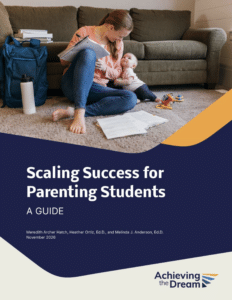
A quarter of community college students are parents, yet colleges may not always know who their parenting students are or fully understand the experiences that shape their journeys through higher education. Achieving the Dream’s new Scaling Success for Parenting Students guide goes beyond identifying the challenges parenting students face. Drawing on the experiences of seven community colleges, the guide highlights practices that helped institutions better identify and understand parenting students, strengthen institutional supports, and improve persistence — offering colleges a practical starting point for turning what they learn into action.
We spoke with the guide’s authors ATD’s Meredith Archer Hatch, director of network relations, and Melinda Anderson, Ed.D., executive director for network engagement, about what makes this guide unique, what colleges can learn from the institutions that contributed to it, and how colleges can begin strengthening their support for parenting students.
Q: What makes this guide different from other resources on supporting parenting students, and how can colleges use it to strengthen their work?
Meredith: This guide is different because it’s grounded in what seven colleges built over two multi-year cohorts, and it’s some of the first institution-level evidence linking specific practices to improved parenting student persistence. One in four community college students is a parent. As one parenting student put it, “We don’t all have a village, and Roane State has become that village.” This guide shows colleges how to become that village too, not just why they should.
Melinda: The guide encourages colleges to examine their policies, practices, data, culture, and student supports through the experiences of parenting students. It helps institutions ask important questions: Do we know who our parenting students are? Do we understand their experiences? Where might our policies or processes create unintended barriers? And are parenting students considered when we design programs, services, and institutional strategies?
Importantly, the guide is designed to support action, not simply raise awareness. Institutions can use it as a starting point for conversations across departments, assess current practices, identify gaps and opportunities, and determine where changes could have the greatest impact.
“Providing excellent resources for parenting students is an important starting point. Colleges can strengthen their impact by ensuring that policies, schedules, advising practices, communications, and campus culture create the conditions for parenting students to access opportunities and advance toward their goals.”
— Melinda Anderson, Ed.D.
Q: Why is it important for colleges to look beyond individual programs and services and examine how institutional policies and practices shape the experience of parenting students?
Melinda: Parenting students experience college as a whole institution — not as a collection of individual programs and services. Providing excellent resources for parenting students is an important starting point. Colleges can strengthen their impact by ensuring that policies, schedules, advising practices, communications, and campus culture create the conditions for parenting students to access opportunities and advance toward their goals.
That is why this shift in perspective is so important. It moves us from asking, “What services do we have for parenting students?” to asking, “How well does our institution work for parenting students?”
When colleges take that broader view, they begin to examine the entire student experience — from enrollment and financial aid to course scheduling, advising, basic-needs supports, and completion. They can identify where institutional practices may unintentionally create barriers and where relatively small changes can make a significant difference.
Meredith: Programs can only reach the students who find them or qualify for them. When support is built into how a college operates, not presented as a special program a student has to seek out and qualify for, it is durable and reflects a student-centered design.
“Whatever your role in this work, the practice that surfaces everywhere is the same: parenting students must play a role. Build with parenting students, not for them.”
— Meredith Archer Hatch
Q: What did you learn from practitioners in various institutional roles about the changes colleges can make to better support parenting students?
Meredith: The recommendations by practitioners are organized by role — administrators, faculty, advising, institutional research, funders, community partners — but one thread runs through every single category: Center the student experience. Administrators are asked to include parenting students in governance. Advisors are asked to build advisory mechanisms for direct student input. Funders are asked to resource compensated listening sessions instead of requiring fully defined solutions upfront.
Whatever your role in this work, the practice that surfaces everywhere is the same: parenting students must play a role. Build with parenting students, not for them.
Melinda: One of the things that stood out to me was how often practitioners pointed to changes that were not necessarily large or costly but required institutions to think differently about how they operate. We sometimes assume that doing a better job of supporting parenting students means creating a new program, finding additional funding, or establishing a dedicated office. What we heard from practitioners was that meaningful change can also come from examining the everyday policies, practices, and decisions that shape a student’s experience.
Regardless of your role at the institution, there is likely something within your sphere of influence that can be examined or adapted to better support parenting students. Faculty can consider flexibility, course expectations, and how they communicate with students. Advisors can think about how academic plans and course schedules account for the realities of work and caregiving. Student affairs professionals can examine how students are connected to resources and whether those resources are easy to navigate. Senior leaders can look across policies, resource allocation, data, and institutional priorities to determine whether parenting students are truly reflected in the college’s student success strategy.
A powerful reminder we can lean into is that institutions do not always need to start by asking, “What new thing should we create?” Sometimes the more powerful question is, “What are we already doing, and how might we do it differently?”
“Waiting costs students time they don’t have. … Meaningful change begins with evidence-informed action. Colleges can begin meaningful change by using the evidence already available, listening to students, and refining their strategies as they learn more.”
— Meredith Archer Hatch
Q: The guide emphasizes an iterative approach to strengthening support for parenting students — taking action, learning from what you find, and refining your approach along the way. Can you tell us more about that process?
Melinda: The guide encourages colleges to start with the information they have, listen directly to parenting students, and use what they learn to identify opportunities to increase support. Institutions can examine existing policies and practices, look at available quantitative and qualitative data, and engage students and practitioners to design supports. As colleges strengthen their ability to identify parenting students and understand their experiences, they can use that information to refine their strategies and practices, assess whether changes are working, and identify where additional attention is needed.
Perhaps the most important lesson is that data should help us ask better questions and make better decisions. The goal is to start, learn, adjust, and continue building a stronger understanding of what parenting students need to thrive.
Meredith: Waiting costs students time they don’t have. Every college began with the Student Parent Opportunity Assessment so they knew their areas of strength and opportunity, and they’d heard from students and other important constituents. That was enough to move. Meaningful change begins with evidence-informed action. Colleges can begin meaningful change by using the evidence already available, listening to students, and refining their strategies as they learn more.”
Q: The guide identifies seven cross-college practices that emerged across participating colleges. If a college is not ready to implement all seven practices at once, where should it begin?
Melinda: A good place to begin is by listening. Talk with parenting students about their experiences. Engage faculty and staff who work to support their success. Examine the data you already have. Ask where students are encountering challenges and where existing practices are working well. Even if you do not yet have comprehensive data, those conversations can reveal a great deal about where to focus first.
Meredith: A great place to begin is where real opportunity sits. Roane State used that starting point to add one self-identification question, “Are you caring for minor children in your home?” to a portal students were already using, based on a similar question that had worked well before. To go further faster, you can use the guide’s implementation self-assessment to see where you are with the practices.
“When we listen to students, use data to better understand their experiences, examine our own practices, and work across departments to create opportunities, we create stronger and more responsive institutions.”
— Melinda Anderson, Ed.D.
Q: What lessons from this work do you hope colleges will take beyond parenting student success?
Meredith: The how matters as much as the what. Colleges approached this work with discipline and strengthened their systems as they implemented. They built the accountability into the effort: naming who is responsible for the work, changing policies and team structures where needed, and measuring as they went rather than after the fact. These lessons extend beyond parenting students, pointing to a broader opportunity to strengthen institutional approaches to student success through alignment, coordination, assessment, and ongoing refinement and improvement.
Melinda: Parenting students make especially visible some of the challenges that many of today’s learners face — balancing work and family responsibilities, navigating complex institutional processes, managing financial pressures, and trying to fit college into already full lives. Practices that create greater flexibility, clearer communication, more coordinated support, and easier access to resources can benefit adult learners, working students, first-generation students, caregivers, and many others.
I hope colleges take away the importance of designing from the student experience. That means asking not only whether a service or resource exists but whether students can find it, access it, and use it when they need it.
Perhaps most importantly, this work reminds us that student success is a shared institutional responsibility. When we listen to students, use data to better understand their experiences, examine our own practices, and work across departments to create opportunities, we create stronger and more responsive institutions.
Ultimately, the lessons from this guide extend well beyond parenting students. When we design for students whose lives are the most complex, we often make college work better for everyone.
Dowload Scaling Success for Parenting Students: A Guide