 Research & Reports

As colleges continue expanding access to affordable learning materials, many are confronting a new challenge: How do successful open education initiatives move beyond individual champions to become lasting institutional and statewide practices?
A new study brief from SRI Education, developed in partnership with Achieving the Dream, offers a timely look at what Tennessee’s open education work reveals about the future of scaling open educational resources (OER), open educational practices (OEP), and the emerging role of generative AI.
The brief arrives at an important moment for the field. Across higher education, institutions have made meaningful progress expanding access to affordable course materials, yet many are still working to understand what it takes for open education to move from promising local practice to sustained institutional and statewide change.
Tennessee offers a useful case for examining that question. Over the past several years, the Tennessee Board of Regents (TBR), in partnership with Achieving the Dream and SRI Education, has made significant investments in OER and OEP. Over four years, TBR’s work supported more than 100 projects across 18 public colleges and universities, engaging more than 300 faculty collaborators and investing more than $2 million in faculty-led course redesign. These efforts have helped faculty redesign courses to integrate OER materials, reduce textbook costs, and explore more student-centered approaches to teaching and learning.
Earlier research on Tennessee’s OER and OEP grant program found that students in redesigned courses reported greater engagement, choice, and peer interaction. Pell-eligible students earned significantly higher grades, and all students demonstrated stronger participation and social-emotional outcomes (Joshi et al., 2025). These findings underscore the promise of open education for student success and provide important context for the new SRI brief, which turns to a related question: What conditions help OER scale?
The new brief suggests that Tennessee has built a strong foundation for open education. It also shows that the next stage of the work depends on strengthening the systems and supports that make open education more visible, connected, and sustainable over time.
One way to visualize this progression is an arc moving from individual champions to department adoption, to institutional commitment, and ultimately to statewide adoption.
Key terms
Open education uses OER and OEP to remove barriers and enable materials to be reused, revised, and redistributed for more accessible teaching and learning.
Open educational resources (OER) are openly licensed teaching materials. OER may include textbooks, videos, tests, and assignments.
Open educational practices (OEP) are teaching practices that use OER to engage students as active contributors and center their backgrounds, needs, and voices in learning.
Scaling is the process of expanding an educational innovation so it reaches more students, deepens instructional practice, advances outcomes for all learners, and becomes sustained through institutionalization.
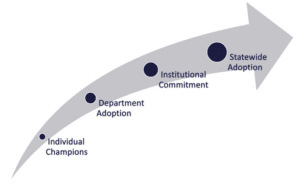
Exhibit 1. From Individual Champions to Statewide Adoption
Study by the Numbers
In 2025, SRI conducted a research study to understand Tennessee’s scaling progress. The study collected data from:
• 5 institutions across Tennessee
• 33 interviews with administrators, librarians, instructors, and system leaders
• 5 course tours with instructors who used GenAI to support OER
• 6 professional learning observations on scaling OER and on using OER with GenAI
This arc captures the developmental nature of the work. Open education often begins with committed individuals who adopt OER because they see a direct connection to student success. These faculty and staff leaders may be supported by catalyzing investments such as grants, professional learning, librarian expertise, instructional design support, or peer collaboration. Over time, the opportunity is to build individual and team-based innovation toward more sustained institutional practice.
As described in the new SRI brief, scaling requires attention to both the institutional conditions that support open education and the implementation supports that help faculty and staff carry the work forward. Scaling is not about replacing grassroots leadership with top-down mandates. It is about connecting and sustaining the work that faculty, librarians, instructional designers, administrators, and state partners have already made possible.
Alignment with institutional mission and vision
One of the strengths highlighted in the brief is the close alignment between Tennessee colleges’ institutional missions and the principles of open education. Affordability, access, and student success are already central priorities for many institutions, giving leaders and practitioners a shared language for why OER matters. At the same time, the next stage of the work involves connecting OER more intentionally to formal institutional processes such as strategic planning, budgeting, curriculum review, scheduling, faculty recognition, professional learning, and institutional research, which would allow OER to embed into key institutional routines.
Supports for course development
The study also found that OER work requires time and pedagogical expertise. Faculty identify materials, understand licensing, evaluate their quality, revise content, align resources to learning outcomes, address accessibility, and maintain materials over time. Supporting it well means recognizing the labor involved and creating conditions that make it easier for more faculty to participate.
In Tennessee, grants, stipends, release time, librarian support, instructional design support, and peer collaboration helped make OER work more feasible. These supports also helped faculty move from interest to implementation. One instructor captured the importance of dedicated support by saying, “When you’re getting paid to do something, it becomes a priority.” When institutions provide time, recognition, and support for OER, they communicate that course redesign, affordability, accessibility, and open practice are part of meaningful teaching and learning work.
Leveraging GenAI for scaling open education
Generative AI (GenAI) has the potential to reduce one of the biggest barriers to OER adoption: the time required to create, adapt, and maintain course materials. Faculty may use GenAI tools to summarize materials, generate examples, simplify dense passages, create discussion prompts, draft quiz questions, adapt readings for different levels, and brainstorm ways to make content more relevant for students. In Tennessee, a few instructors were beginning to explore these possibilities, with some using GenAI to support course design and instructional preparation. These early uses suggest that GenAI may become a useful support for reducing the time involved in adapting and maintaining open materials, especially when paired with human review, disciplinary expertise, and clear guidance.
As these practices develop, GenAI also raises questions that connect directly to long-standing open education values. AI-assisted content needs human review for accuracy, accessibility, bias, and attribution. As several faculty noted, more guidance is needed on authorship, copyright, transparency, and responsible use.
In short, the critical question is how AI can help educators create, adapt, and sustain learning materials in ways that are transparent, trustworthy, student-centered, and open.
What may be evolving is a narrow view of OER as primarily a free textbook replacement. The next phase of open education is likely broader. It can focus on adaptable learning ecosystems, shared improvement, student-centered pedagogy, and responsible use of emerging technologies.
Looking ahead
The brief points to a hopeful next stage for open education: strengthening the conditions that allow promising work to grow, connect, and endure. That means supporting faculty with time and incentives; recognizing the expertise of librarians and instructional designers; helping departments share and improve materials together; distinguishing OER from other no-cost materials in useful ways; building data systems that can track both affordability and instructional impact; and helping educators use GenAI responsibly in support of human judgment and learning.
Individual champions remain essential to this work. Tennessee’s progress reflects the leadership of faculty, librarians, instructional designers, administrators, and state partners who have helped open education take root across the state. The next opportunity is to build institutional structures that honor that leadership, extend its reach, and make open education easier to sustain.
Findings from the SRI study offer a moment to reflect not only on what Tennessee has accomplished but on what the field can learn from this work. Open education is entering a new phase, shaped by growing institutional experience, renewed attention to scale, and the emergence of GenAI. The opportunity now is to build on the foundation already created and continue advancing open, adaptable, student-centered learning at scale.
About the authors
Susan Adams is associate director of teaching and learning at Achieving the Dream, where she supports colleges in advancing student-centered teaching, open educational practices, and responsible uses of generative AI. Through ATD’s partnership with the Tennessee Board of Regents, she helped design and facilitate professional learning and capacity-building opportunities for Tennessee institutions working to scale OER and OEP. Ela Joshi, PhD, is a senior education researcher at SRI Education, where she leads mixed-methods studies focused on education implementation, scaling, and improvement. Through SRI’s research on Tennessee’s open education efforts, she leads activities examining the institutional conditions, implementation supports, and emerging role of generative AI in advancing and scaling OER and OEP.
References
Joshi, E., Griffiths, R., & Lawrence, J. (2025). Students’ and instructors’ experiences with open and culturally responsive instruction: Findings from a State OER Program. SRI International. https://www.sri.com/publication/education-learning-pubs/digital-learning-pubs/students-and-instructors-experiences-with-open-and-culturally-responsive-instruction-findings-from-a-state-oer-program/