 Thinking & Advocacy
Good morning. Thank you, LiiLii and all of the DREAM Scholars who feed our hope for the future with your leadership — something I have been thinking about a lot leading up to today.
What I have concluded is that leadership is not just about what we build it is about what builds us.
And so, as I thought about this moment — my last DREAM as president of this amazing organization — I found myself returning, over and over again, to the moments that shaped me. I’ve tried to capture these moments in this piece titled “What I Carry Forward.”
View Dr. Stout's plenary address as a PDFWhat I Carry Forward
There was a moment before I knew what was possible
and what was not.
A bat.
My new A2000 glove.
Pepper in the backyard with my dad—
ball to leather to throw—
again, again, again—
as if repetition itself could build a future.
My brother and I staged our own spring training,
imagining stadium lights we had never seen.
I claimed third base as if it were destiny.
Brooks Robinson was the standard.
I was certain I was next.
I did not yet understand
the quiet boundaries of the world.
Only later did I learn
that some doors were not built for me to walk through.
There was a moment
when my mother mailed me a classified ad
for a job
at my hometown community college.
She wanted me to come home.
Of course, I applied.
I was rejected.
Twice.
And, then I said yes
to a random phone call
for a conversation with a search committee
for that same job.
Two weeks later,
my life in community colleges began.
And I learned something about humility.
And something about how saying yes
can open doors
that pride would rather keep closed.
There was a moment
when a strategic plan failed—
a big, public failure—
not because the thinking was weak,
but because the politics were not ready
for the thinking.
And I learned
that ideas do not move institutions—
relationships do.
Timing matters.
There was a moment
when a mentor pulled me aside
and said I would make
a good community college president.
The same quiet certainty
a coach once held
in my early field hockey days.
The same encouragement
Mr. Moore offered in fifth grade
when he fed my curiosity
with every book I asked for
and then a few more.
And I learned that sometimes
others see our future
before we do.
There was a moment during the pandemic
when uncertainty stripped everything bare—
food insecurity,
housing instability,
isolation,
fear.
And community colleges responded—
not perfectly,
but relentlessly.
And I learned what caring
combined with endurance
looks like at scale.
There was a moment when I was thirty
and a brain hemorrhage
stopped everything.
Six months away from work.
Learning to walk again.
Learning to speak again.
Learning patience
in ways I never would have chosen.
And I was held—
by a village of community college colleagues
who refused to let me disappear.
And I learned that strength
is not independence—
it is interdependence.
There was a moment,
on a visit to a Tribal College,
when a student kept shaking her head,
repeating one number:
four hundred fifty-seven dollars.
The amount she owed
to register,
to finish,
to complete a degree
she was six credits away from earning.
And I was reminded
how small barriers
can interrupt big dreams.
And that leadership lives in the details—
and that we are responsible
for removing the barriers
we can and can’t see.
There was a moment
when the words
became contested.
When the attacks were not abstract
but felt aimed directly
at the students we serve.
And we made a choice—
not to allow others to trap us
between the words
and the work.
And I learned that clarity of mission
must outlast noise.
There was a moment when I was removed
From the National Council on the Humanities—
When some voices were deemed more worthy
Than others
To define the work.
And I learned that when the circle narrows.
We widen it.
And I turned my attention
To lifting the role of community colleges
In the humanities
Louder, clearer, and more urgently than before.
There were moments
doing homework beside my father,
eight years of “night school”
as he worked toward his degree.
His graduation gown
is etched in my memory.
I was in fourth grade.
And I learned that education
is not linear.
It is not solitary.
And it is never just about one person.
There was an email.
Then a call.
And suddenly,
a twenty-million-dollar gift.
Not a finish line—
but a responsibility.
And I learned that belief from others
can create the platform
for possibility.
There is a moment now—
returning to field hockey,
realizing again
that no matter how long you’ve been “in the game”
you are never so proficient
that you do not need coaching.
That being part of a team
means accountability
to something larger than yourself.
And I am reminded
that leadership, too,
is a team sport.
There was a moment early in my career
when a colleague advised me
that I would never lead
if I shared my life openly.
So I didn’t.
I moved through my early career—
and even my presidency—
quietly.
Until a student leaned in,
whispered in my ear,
and in that whisper
I found my courage.
And I learned that authenticity
is not a liability—
it is a responsibility.
Last year,
between Zoom meetings,
my partner of thirty-two years and I
finally got married.
It turns out
even long commitments
can still surprise you with joy.
There were moments after I joined ATD
when life outside the work
kept happening—
the loss of both my parents,
a recent cancer diagnosis.
And still, somehow,
the red thread of this mission carried me.
I stayed with the work.
I stayed with the responsibility.
I stayed with the belief
that adversity does not narrow our purpose—
it clarifies it.
I feel the absence of my parents every day.
And still, they remain my vision supporters—
the quiet voices urging me
to keep choosing what matters.
What I Know Now
Our work is like a poem. It is a fragile human thing that begins with stories of our students and ourselves. We continue to create it, though we don’t know exactly where it will lead us. The facts of our lives and experiences in our work lead us to who we are and how we change and influence the lives of others.
This is what I know now.
I know now that leadership is shaped as much by interruption as by intention and that staying the course is not heroic. It is practiced — often quietly.
I know now that systems and reforms fail when we design for people instead of with them.
I know now that data is never neutral — it carries the weight of lives, of dollars, of doors that open or remain closed.
I know now that being a silent role model is not enough. That students deserve to see possibility spoken aloud.
I know now that partnership is shared purpose, shared risk, shared responsibility.
I know now that commitments matter most when they are hardest to keep.
I know now that institutions change only when people choose — again and again — to stay focused on what matters most.
I know now that none of us is ever beyond coaching. And none of us does this work alone.
I know that I am humbled to have been with ATD and with you through a series of climbs — some steady, some steep — to bring us to this point.
So now I want to think about where we are and where we are going and the deeper question: What do WE carry forward from here?
The Evolving Cycles of Our Movement
You’ve heard me talk before about the evolving cycles of our movement.
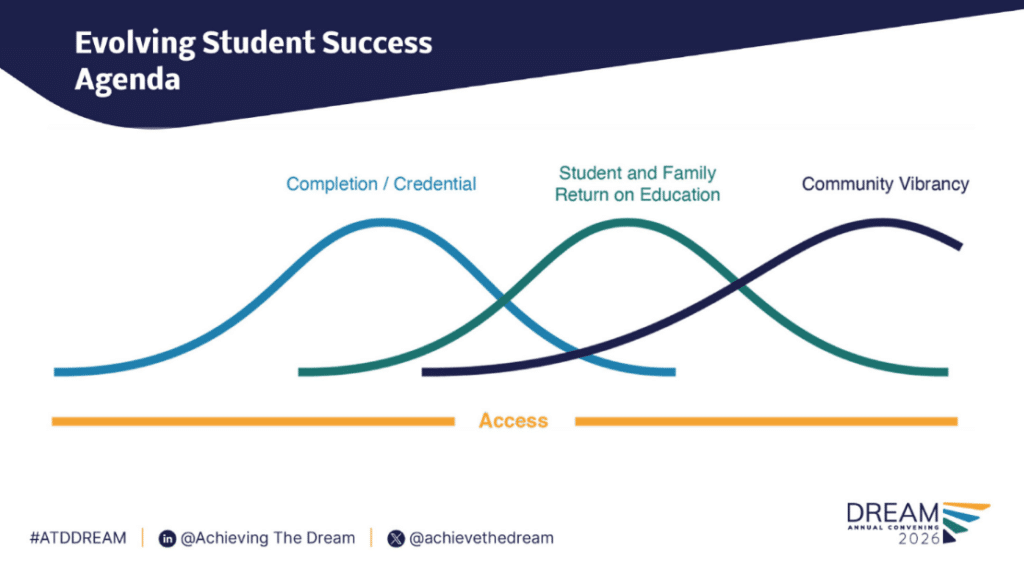
These are not phases of a movement that are completed but, rather, ones that we continuously reshape to help our students on their own ascents.
We have made measurable progress on completion, expanding our view to include associate and bachelor’s degrees and non-degree credentials. And we recognize that completion is not an end in and of itself — it is a progression metric.
We are linking program momentum and completion to mobility, the return on education (note my language — it is not return on investment) for students and their families. We are beginning to link that mobility to how it translates to community vibrancy.
And, anchoring this evolution is our new thinking on access as being multidimensional and tied to affordability, but, more importantly, challenging us to ask new and constant questions about who is missing and who is benefiting — not just upon entry but all the way through a student’s experience into and through our colleges and into our communities.
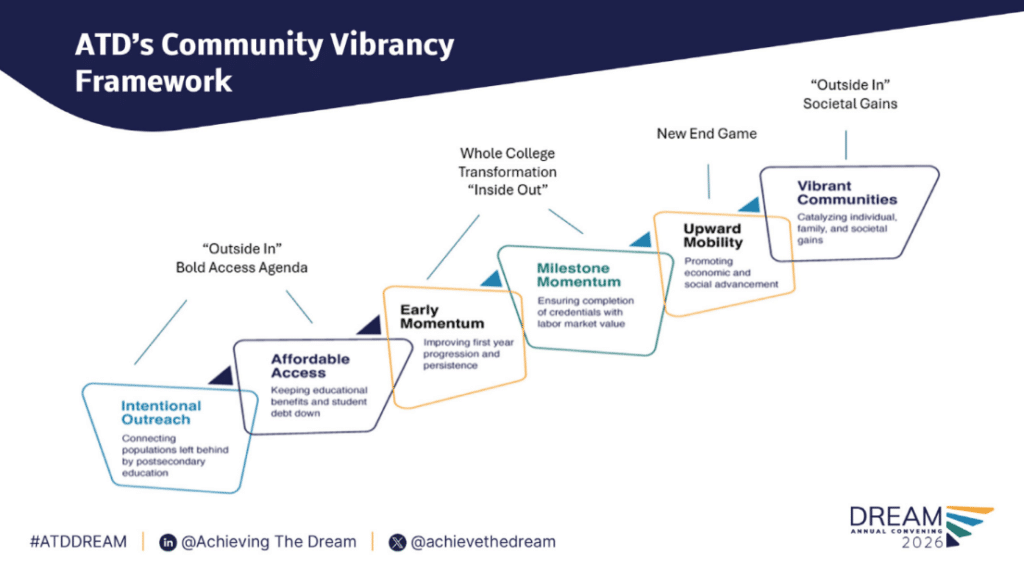
The Community Vibrancy Framework is resonating — not because it is new language but because it gives us the ability to connect these important aspects of our work in a logical framework that centers our students and communities, and that helps us to reclaim the narrative around our value.
It gives us language to defend our mission, to assert our relevance, and it helps us reclaim our civic identity as much as it connects to economic mobility.
Intention vs. Mission Blur
Of course, the framework alone is not enough; how we implement it matters, and that will take a different kind of innovation. Innovation that isn’t necessarily about inventing new levers but, rather, about pulling the right levers — together — with intention.
Researcher and author Xueli Wang reminds us that innovation in community colleges is rarely about disruption — it is about disciplined redesign rooted in equity, which requires a deep understanding of our students and our communities.
In this next decade, intention is not just the glue of leadership that I alluded to earlier, it IS the innovation.
Intention means that we must also pay attention to our blind spots and bring forward the questions that allow us to look around corners.
Blindspotting is the practice of being honest about the ways our thinking can be flawed, being curious about what we may be missing, and being flexible enough to see the whole picture. Let me suggest five areas where I believe we still have intentional work to do and where blindspotting will be important.
First, despite some arguing we have overachieved on access — that fewer students should go to college — the access agenda is not complete. We must find students where they are, the hidden talent in communities, and ensure that we are gateways to opportunities and not gatekeepers.
For me, the urgency around embracing this agenda is stronger today than when I started speaking about its urgency about three years ago. Today, I also see access as an essential value that our sector must fight to preserve because, as a concept, it is under attack with proposed financial aid restrictions; attacks on accreditation, which is the gateway to this funding for our students; reductions to public benefits; some states now moving to add a civic learning test as an admissions tool; child care reductions; new limits on health care access; and even immigration policy. It is now our imperative to embrace a new access agenda to reach those in our communities whom we have left behind AND to protect the traditional notion of access upon which we were founded as a sector.
Second, our gaze must include not just courses but programs — and not just programs but a focus on our program portfolios and how the range of options we offer brings long-term value for students and families. Innovation as intention means we must ensure that all students who come to us have clear pathways to credentials of value.
We must NOT get mired in the thing of the moment. It is tempting to spend a disproportionate amount of time designing short-term Pell-eligible programs, programs we still have many questions about, at the expense of working on important degree programs, transfer pathways that end in bachelor’s degree attainment, and our own new bachelor’s degree programs that all have proven mobility gains for students.
Third, mobility is our new end game. The field, with leadership from the Community College Research Center, has done important work to normalize early momentum metrics so we could get to the right questions to accelerate college completion faster. Our next data frontier must include the development of a field-based and normalized definition of mobility. That definition should be localized but also able to be benchmarked and be transparent to help colleges and those we serve understand how credentials lead to wage gain, career preparedness, licensure success, civic participation, and more.
Fourth, it is time for our sector to seize this moment and use time as a lever. Just as we work to compress the time to degree for students, it is now time to compress the time to results for ourselves. We must compress the time between knowing and doing.
This will require us to focus with intention on leadership at all levels within our organizations, developing the next generation of leaders by lifting up those in the room who lead programs, and faculty, to have more ability to make decisions that make our organizations more agile.
Advancing this new leadership agenda will require new kinds of shared leadership models inside and outside our organizations. We need leadership that is supported by both the extraordinary leadership programs across our field that prepare presidents AND embedding leadership development at all levels and for all employees, full- and part-time, within our organizations.
If, as leaders, we don’t approach mission with intention, and we allow our colleges to organically move without strategy and evidence of scaled necessity, we could lose our way. Some may call this “organicness” mission blur, for which we are often criticized. But when approached with intention, this apparent mission blur is really about the form each one of us takes to fulfill the hopes and dreams of our students and our local communities.
Leaders will be challenged in the future, even more than they are now, to describe what their colleges do and the value their colleges bring to students and communities. This is especially important at this moment, when others may be defining our sector as solely workforce organizations without the important heart Dr. Lewis brought into the room yesterday.
Fifth is renewing our commitment to building a culture of teaching and learning excellence, the blind spot I noted for us in 2018 in my Dallas Herring Lecture (and a blind spot that still exists today). I can’t wait to explore this in the upcoming fireside chat.
The challenge of taking on learner success within college and post-college and transforming communities is so large. Activating this large intention requires commensurate changes of magnitude in how we think and work — in our way of being.
If we lean into what we know and align how we work and how we are funded to what we know, then this next decade will not be about defending our mission; it will be about fulfilling it. And in that leaning in, with intention, is the innovation.
What We Carry Forward
So let me return to the theme that I started with. This is what I believe will carry us forward.
I believe in open-door institutions and the radical promise they hold.
I believe that when words are contested, the work must continue.
I believe in this community and in our collective willingness to keep choosing courage, even when the path forward is not clear.
I believe data must serve dignity and strategy must serve people.
I believe leadership is stewardship — for those who came before us, for those still finding their way, and for those who will follow.
It has been the honor of my life to serve this amazing organization. To lend my voice to a movement powered by so many voices stronger than my own.
To walk alongside leaders I admire.
To learn from students who never stopped teaching me what matters.
To work with colleagues within ATD who have given their all and have had to meet constantly rising expectations and continue to find new ways to serve colleges and reinvent and execute the work of the organization.
To thank, from the depths of my heart, those who have carried ATD since the beginning, who hold the same belief in our “why” that I do, whose enduring passion has been the glue — the quiet, faithful glue — that keeps us moving forward together.
So I move forward. Not stepping away from this work but stepping into it differently — no longer at the center but firmly in the circle. As a participant. A partner. A believer. Grateful for what we have carried together. Trusting what you will carry forward. And confident — deeply confident — in what we will continue to build together.
Mastery is not arrival. It is continuous reaching. Let us reach together.
Thank you.