Stories & Case Studies
Rappahannock Community College (RCC), one of the newest additions to the ATD Network, sits in a picturesque region of Virginia’s Middle Peninsula and Northern Neck. It is the only institution of higher education in its 12-county service area and serves as a critical doorway to economic opportunity for its community.
Recently, the college has accelerated its efforts to support parenting students. In 2024, RCC secured a grant from the Department of Social Services to launch a program that supports low-income students (those living at 200% of the federal poverty level or lower) with a dependent child under the age of 18. The program, called Career Help and Mentoring for Parenting Students (CHAMPS), offers paid work experiences, career readiness training, peer mentoring, and supportive services to empower parenting students to thrive academically and to foster a strong, nurturing community on campus.
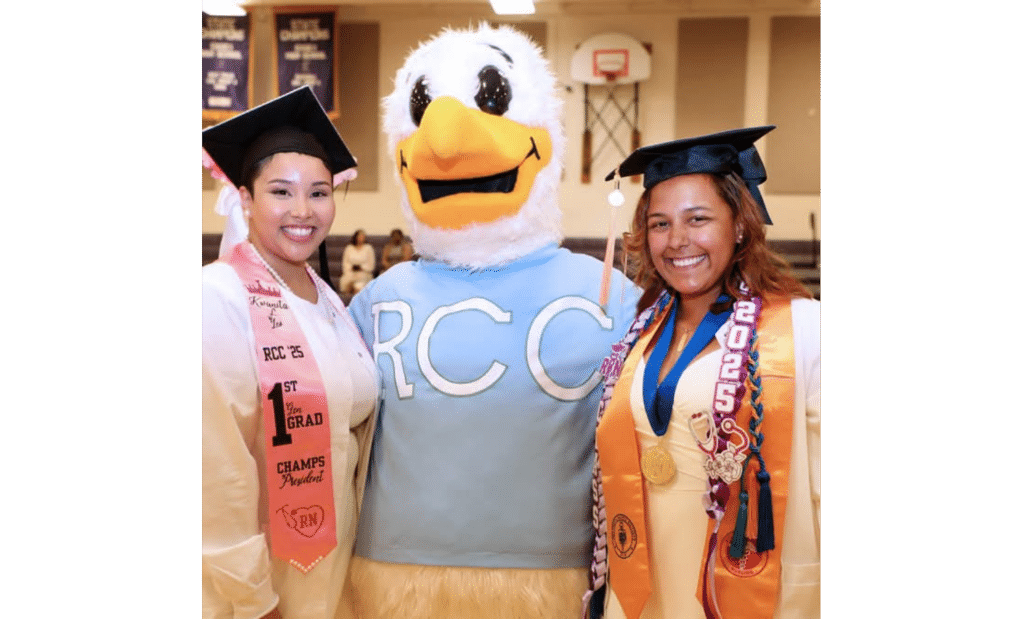
Photo courtesy of Rappahannock Community College.
Addressing barriers
The CHAMPS program aligns with RCC’s strategic goal to improve retention rates, which has been identified as an area of growth college-wide but is a particular concern for parenting students, as Theresa Sirles, primary manager for the CHAMPS program, explained.
“With students who are parents, a lot of time their grades are great, they’re doing exceptionally well, but they’re one car breakdown away from missing class and missing work — and now they’re no longer a student,” Sirles said.
Recognizing that parenting students face specific barriers to continuing and completing their education, RCC offers supportive resources through multiple avenues. Through CHAMPS, students receive a work experience stipend of $1,000, weekly incentive cards to help with groceries or gas, and the support of two certified career coaches.
Sirles expects that CHAMPS will serve 100 students this academic year: Those students have access to resources from other departments and programs, such as tailored supports for first-generation college students and assistance through a Workforce Innovation and Opportunity Act grant.
This multipronged approach to student support, Sirles said, is “the college’s way of strategically making sure that you meet students where they are, that you put the supports in place to address every possible barrier.”
To address those barriers, colleges need to begin with a comprehensive, data-informed understanding of their parenting student populations. This can be difficult information for institutions to obtain, and Sirles recognizes that data collection is an area of active improvement for RCC and for the Virginia Community College System as a whole. It will also be an area of focus for college leaders as they continue ATD’s Foundations of Transformation experience, a three-year engagement they began early in 2025 alongside other new Network colleges. Sirles is optimistic that as RCC’s data on parenting students “gets stronger,” so will the support the college can offer this population.

Photos courtesy of Rappahannock Community College.
Community connections
The CHAMPS program helps provide parenting students the support they need to continue their education so that they can complete their credential or transfer to a four-year institution and access greater opportunity for their families.
Despite the large 12-county service area, the region RCC serves has relatively limited employment opportunities, according to Sirles. Longstanding industries like fishing, shipbuilding, and paper milling provide some work, but RCC’s biggest employment partner by far is the health care industry. As a result, RCC’s nursing programs and related credentials see high enrollment.
Sirles said that part of her work in the CHAMPS program is to help parenting students understand the range of opportunities to them available in a field. “Sometimes we have students who think their only opportunity is in hospitality or doing a job like CNA that pays very little. And so our job is to help encourage them to reach higher,” Sirles said.
RCC helps students access those higher-paying opportunities in part through robust partnerships with regional employers that enable students to gain paid on-the-job experience, such as clinical hours in a nursing program, while pursuing a credential.
“That’s what really helps,” said Dr. Ebony Lynch, career coach for the CHAMPS program. “Students get their foot in the door before they even graduate, so once they have that work experience, then they’re more likely to get hired after graduation.”
In the 2023–24 academic year, the CHAMPS program celebrated three parenting students who graduated from RCC’s nursing program and are now working as registered nurses — two of these parents are also continuing their studies at a four-year institution.
CHAMPS staff are focused on connecting students with career paths that align with their interests and skills. The program recently connected two students to work experience opportunities at local nonprofits, where they could begin pursuing work in fields they were passionate about. This type of workforce pathway has generative benefits not just for the students but also for the community as a whole.
“They’ve been able to connect with the nonprofit, earn a stipend, and gain experience on their résumé, and, at the same time, they’re contributing back to their community,” Sirles said.
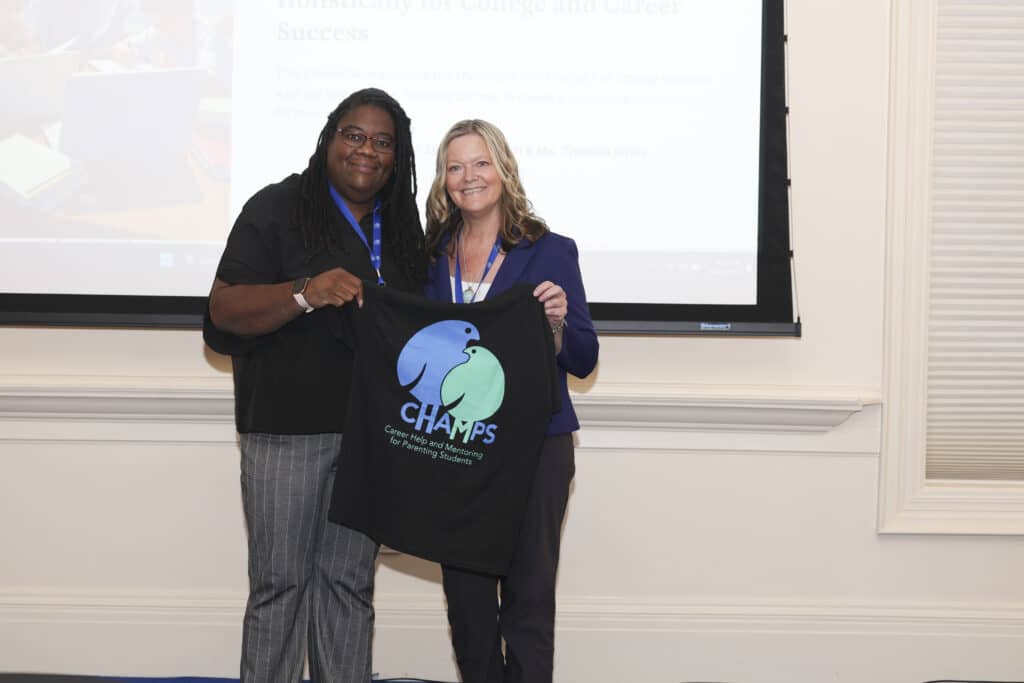
Dr. Ebony Lynch and Theresa Sirles at the 2024 VCCA Conference. Photo courtesy of Rappahannock Community College.
Belonging, pride, and confidence
As the CHAMPS program enters its second year, RCC leaders are already sharing their findings and strategies with peer institutions. The college participated in a planning retreat sponsored by the Virginia Community College System to help other colleges implement similar programs for their parenting students.
When asked at a recent Virginia Community Colleges Association Conference what RCC’s students like most about CHAMPS, Sirles said her response was immediate: The t-shirts.
“The point was that it’s the sense of belonging and pride and confidence” that the program has instilled in its participating students, Sirles explained.
Often, parents and caregivers who don’t fit the mold of “traditional” student may feel like they don’t belong on a college campus. Between caregiving and work responsibilities, financial challenges, and scheduling constraints, parenting students face specific barriers that affect their ability to persist in higher education. But with strategic supports and intentional outreach, colleges can lower those barriers.
Whether through peer-to-peer support or financially incentivized work experience opportunities, CHAMPS is meeting the needs of parenting students from multiple angles — including their psychological and emotional needs.
“Part of the reason we enjoy this work,” Sirles said, “is that the students come back and say, ‘Hey, I didn’t think I could do it. I started small, and now I have my four-year degree,’ or ‘Now I’ve moved on to this level of nursing.’ So that’s really the most important part of the program.”

 Research & Reports